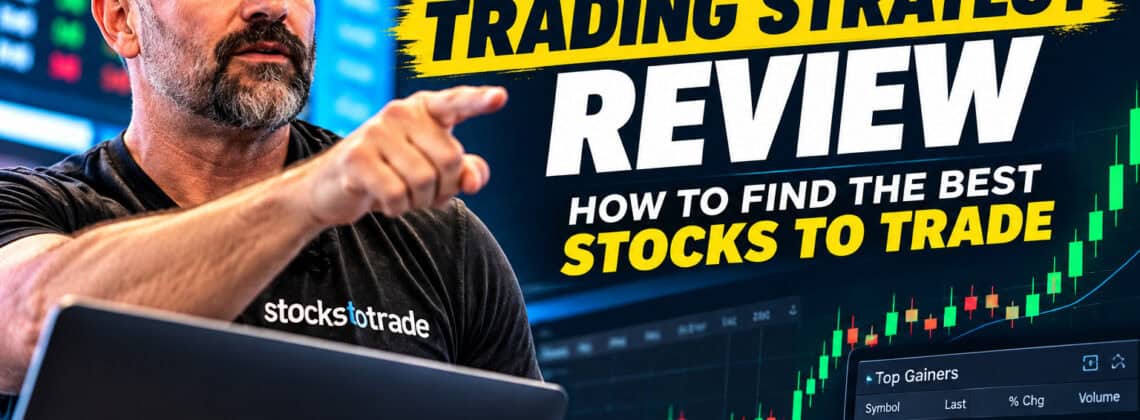
Looking for Better Stock Trade Ideas? See How Tim Bohen Approaches the Market
Affiliate Disclosure: This article contains affiliate links. If you purchase a product or service through one of these links, I may receive a commission at no additional cost to you. Tim Bohen Trading Strategy Review: How to Find the Best Stocks to Trade.
If you’ve ever opened your trading platform in the morning and wondered, “What stocks should I actually be watching today?”, you’re definitely not alone.
There are thousands of stocks available to trade, countless indicators to follow, and an endless stream of financial news competing for your attention.
For newer traders especially, the hardest part often isn’t placing a trade.
It’s figuring out which opportunities are worth paying attention to in the first place.
That’s where veteran trader and StocksToTrade lead trainer Tim Bohen comes in.
Tim has spent years studying active stocks, momentum, volatility, breakouts, and the patterns that can sometimes create interesting short-term trading opportunities.
And if you’d like to see the type of trading opportunities and setups Tim is currently watching, you can check out his presentation here:
Watch Tim Bohen’s Trading $1 Trader Presentation Here
Why Finding the Right Stocks Can Be So Difficult
One of the biggest mistakes beginning traders make is assuming they need to predict what the entire stock market will do.
But active traders often approach things differently.
Instead of trying to predict every move in the S&P 500, they may search for individual stocks displaying unusual characteristics such as:
- Increased trading volume
- Strong price momentum
- News catalysts
- Breakouts above important price levels
- Unusual volatility
- Low-float momentum
- Clearly defined support and resistance levels
The idea isn’t necessarily to predict what will happen.
It’s to identify interesting situations and develop a trading plan before taking action.
That distinction is important.
Who Is Tim Bohen?
Tim Bohen is the lead trainer at StocksToTrade and has been involved in trading for many years.
His approach places a strong emphasis on preparation.

Rather than simply jumping into whatever stock happens to be moving, Tim teaches traders to look for specific setups and determine important levels before entering a position.
That means asking questions such as:
Where would I enter?
Where would I take profits?
Where am I wrong?
How much am I willing to risk?
These questions can help turn trading from an emotional guessing game into a more structured process.
You can learn more about Tim’s approach in his presentation:
Click Here to Watch Tim Bohen Explain His Trading Approach
The Importance of Having a Trading Plan
One of the most valuable lessons a new trader can learn is that finding a stock is only part of the process.
You also need a plan.
Imagine discovering a stock that’s rapidly climbing.
You buy it because you’re afraid of missing out.
The stock keeps climbing for another few minutes.
Then suddenly it reverses.
Now you’re staring at the screen wondering:
Should I sell?
Should I hold?
Will it bounce?
This is where traders frequently get themselves into trouble.
A structured trader tries to answer those questions before entering the position.
For example, a trading plan might identify:
- A potential entry level
- A support level
- A profit target
- A stop-loss level
- The maximum amount of capital to risk
You still won’t know what the stock will do.
Nobody does.
But you’ll know what you plan to do depending on how the stock behaves.
Watch Tim Bohen’s Trading $1 Trader Presentation Here
Why Risk Management Matters
Finding exciting stocks gets most of the attention in trading.
But protecting your account may be even more important.
Every trader experiences losing trades.
That’s simply part of participating in financial markets.
The objective isn’t to eliminate losses completely. It’s to prevent individual losing trades from causing excessive damage to your trading account.
Tim frequently emphasizes having defined risk levels and cutting trades when the original trading thesis no longer makes sense.
That’s particularly important when trading volatile stocks.
The same volatility that can create an opportunity for a rapid gain can also produce a rapid loss.
Trading With a Smaller Account
Another interesting aspect of Tim’s approach is his focus on opportunities that may be accessible to traders who don’t have enormous accounts.
You don’t necessarily need hundreds of thousands of dollars just to begin learning about trading.
Lower-priced stocks can sometimes allow smaller-account traders to participate with relatively modest position sizes.
However, there’s an important distinction:
Being able to trade with a small account doesn’t mean you should take large risks with it.
If you’re just starting out, education and practice should generally come before attempting to make significant profits.
StocksToTrade even provides paper-trading functionality that can allow traders to practice strategies without immediately risking real money.
Why Trading Tools Can Help
Professional traders don’t normally sit around randomly clicking through stock charts hoping to discover something interesting.
They use scanners, watchlists, alerts, charts, and other tools to narrow thousands of stocks down to a much smaller list.
That’s one of the ideas behind StocksToTrade.
The platform is designed to bring several pieces of the trading process together, including market scanning, charting, watchlists, research, alerts, and trading education.
Instead of trying to watch the entire stock market, traders can concentrate on stocks that meet particular criteria.
Technology doesn’t eliminate trading risk.
But the right tools can make researching and preparing for trades significantly more efficient.
Watch Tim Bohen’s Trading $1 Trader Presentation Here
Learn the Process Instead of Chasing Hot Stocks
There’s always another “hot stock” being discussed online.
Today it might be artificial intelligence.
Tomorrow it might be biotech.
Next month it could be something completely different.
Trying to chase every popular stock can quickly become exhausting.
A potentially better long-term approach is learning how to recognize the characteristics that make a stock interesting in the first place.
That’s ultimately what makes trading education valuable.
Instead of simply asking:
“What stock should I buy?”
You start asking:
“Why is this stock moving, what setup am I seeing, and what would my trading plan be?”
That’s a much more useful skill to develop.
Is Tim Bohen’s Approach Right for You?
Tim Bohen’s material may be worth exploring if you’re interested in:
- Day trading
- Momentum stocks
- Lower-priced stocks
- Breakout trading
- Technical analysis
- Stock scanning
- Building watchlists
- Learning better risk management
- Developing structured trading plans
It may also be useful if you’ve already experimented with trading but feel overwhelmed trying to determine which stocks deserve your attention.
The goal shouldn’t be to blindly copy another trader.
Instead, use experienced traders as an opportunity to learn how they think, prepare, manage risk, and evaluate potential setups.
Watch Tim Bohen Explain the Strategy
If you’re interested in becoming a more structured trader, the next step is simply seeing how the strategy works.
Tim has put together a presentation explaining the trading approach and the types of opportunities he looks for.
Click Here to Watch Tim Bohen’s Trading Presentation
Even if you’re relatively new to trading, studying how experienced traders build watchlists and trading plans can help you understand what separates structured trading from simply gambling on whichever stock happens to be moving.
Take your time, learn the strategy, and never risk money you can’t afford to lose.
Tim Bohen Trading Strategy Review: How to Find the Best Stocks to Trade: Related Articles
Adam Khoo StockOracle Review: My Experience Using Piranha Profits’ StockOracle
JC Parets Primary Trend Review
Day Trade Spy Pick of The Day Review
Olivia Voz Trade to Close Review
Matt Monaco Midnight Madness Review

Leave a Reply