Nate Bear’s TPS Trading System Explained
You can get TrendSpider or learn more HERE!!
Check out Nate Bear Profit Surge Trader alerts and education HERE!
Who Is Nate Bear? The Trader Behind the TPS System
Nate Bear (Nathan Bear) is a professional options trader and trading educator best known for developing the TPS Trading System, a strategy built around three powerful technical concepts: Trend, Pattern, and Squeeze.
Before becoming a full-time trader, Bear worked in the construction industry. His trading career reportedly took off after he developed a systematic approach to identifying high-probability trading opportunities.
According to Bear and Monument Traders Alliance, he used his TPS methodology to turn an initial $37,000 trading account into approximately $2.7 million in trading profits over four years. While these impressive results are widely featured in his promotional materials, they have not been independently verified here.
The appeal of the TPS system lies in its simplicity: identify a strong market trend, locate a recognizable chart pattern, and look for a volatility squeeze that could precede an explosive price move.
Today, Bear teaches his approach through Daily Profits Live, where he demonstrates trading setups and options strategies.
But here’s the interesting question: Could TrendSpider’s artificial intelligence recreate the core principles of Nate Bear’s TPS system, automatically identify similar opportunities, and even improve upon the strategy through backtesting?
That’s exactly what we’re going to explore.
Trend, Pattern, Squeeze — the concepts, chart setups, and an AI-assisted approach to testing them
Nate Bear’s TPS framework focuses on three trading considerations: trend direction, recognizable chart patterns, and volatility compression. The idea is to investigate stocks that show strength, pause, and may then break out. This article discusses a TPS-inspired analytical framework; Nate Bear’s complete proprietary signal rules and calculations have not been independently verified.
What does TPS mean?
- Trend — find stocks with a clear directional bias.
- Pattern — identify a consolidation or recognizable continuation setup.
- Squeeze — look for compressed volatility before potential expansion.
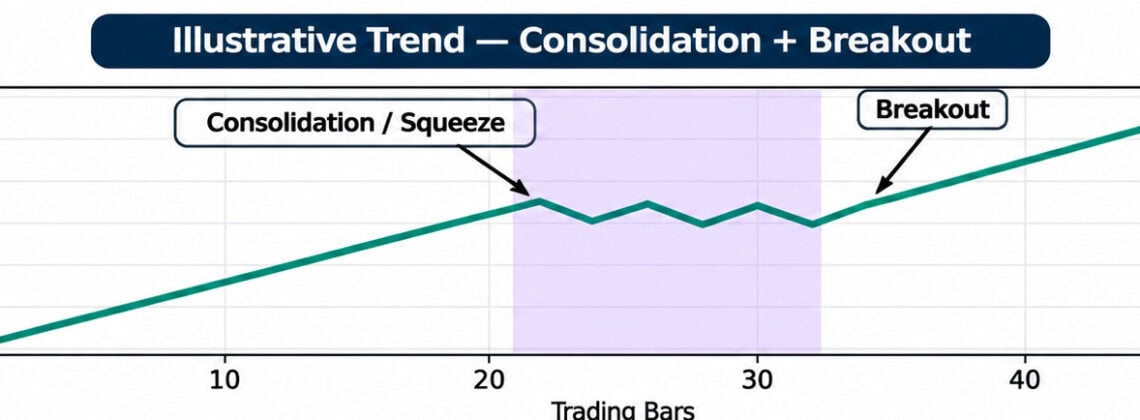
For example, a stock might rally after an earnings announcement, trade sideways for several sessions, then break above the range on increased volume. A TPS-inspired approach helps organize the analysis, but does not predict that the breakout will succeed.
You can get TrendSpider or learn more HERE!!
Check out Nate Bear Profit Surge Trader alerts and education HERE!
1. Trend: identifying momentum
A bullish trend can be characterized by higher highs and higher lows, or measured with moving averages and momentum tools. Example filters include price above a rising 20-period EMA, a 20 EMA above a 50 SMA, RSI above 50, and positive MACD momentum. These are illustrative rules, not verified proprietary TPS settings.
| Example tool | Possible bullish interpretation |
| 20-period EMA | Price trading above a rising average |
| 50-period SMA | Longer-term directional confirmation |
| RSI (14) | Momentum above the midpoint of 50 |
| MACD | Positive or strengthening momentum |
2. Pattern: recognizing consolidations
After a strong advance, a stock may pause in a bull flag, ascending triangle, or tight sideways range. Traders can mark the consolidation high and low, then evaluate whether a subsequent breakout closes above resistance. Volume expansion can provide additional context, though even high-volume breakouts can fail.
- Bull flag: strong advance followed by controlled consolidation.
- Ascending triangle: repeated tests of resistance with rising lows.
- Tight range: a narrow price band following an earlier directional move.
3. Squeeze: measuring volatility compression
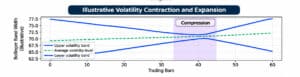
A common, nonproprietary squeeze model compares Bollinger Bands with Keltner Channels. A squeeze condition can be defined when Bollinger Bands lie inside the Keltner Channels. A later expansion can signal a volatility regime change, but not its direction. Common demonstration parameters are Bollinger Bands (20, 2) and Keltner Channels (20, 1.5 ATR); these are not confirmed Nate Bear settings.
Original schematic of volatility compression and expansion, not a historical market chart.
How the components work together
A sample bullish checklist might require: (1) a positive trend, (2) a defined consolidation, (3) a recent volatility squeeze, and (4) a closing breakout with volume confirmation. Each additional condition can reduce signals and may also delay entries. The combination must be tested rather than assumed superior.
Can TrendSpider AI build a TPS-inspired indicator?
TrendSpider offers tools for custom indicator development, market scanning, and strategy testing. An AI-assisted workflow can turn a plain-language description into a first draft of indicator logic, but platform support and implementation details should be verified in the software. This would be an independent approximation, not Nate Bear’s proprietary system.
You can get TrendSpider or learn more HERE!!
Example AI prompt
Create a custom Trend, Pattern, Squeeze-inspired indicator. Define a bullish trend using a rising 20 EMA, 50 SMA, and RSI above 50. Detect tight consolidations and breakouts above prior resistance. Detect volatility compression using Bollinger Bands (20, 2) inside Keltner Channels (20, 1.5 ATR). Generate a candidate bullish signal only after a completed-bar breakout, with volume confirmation. Include adjustable parameters, defined exits, no future-looking calculations, and clear explanations of unsupported features. Do not claim this replicates any proprietary system.
Is the TPS system profitable?
No publicly discussed chart framework by itself establishes a reliable trading edge. Performance depends on entry timing, stop placement, market conditions, sizing, fees, and—if using options—expiration, implied volatility, and time decay. Evaluate a fixed set of rules on historical data, account for costs, and reserve an out-of-sample period. A stock backtest does not establish the profitability of an options strategy.
Frequently asked questions
Is TPS the same as Profit Surge Trader?
No. TPS refers to a broader technical framework; Profit Surge Trader is associated with earnings-oriented opportunities. They may share concepts, but should not be treated as identical systems.
Can TPS be used for intraday trading?
The general ideas can be applied to intraday timeframes, but signals become noisier and transaction costs more important. Test each timeframe separately.
Can TrendSpider recreate Nate Bear’s exact TPS indicator?
Without the proprietary source logic and settings, an exact reproduction cannot be verified. A transparent, independently built strategy can still be useful for education and research.
Final verdict
Trend, Pattern, and Squeeze provide a memorable way to organize chart analysis. The strongest use of the framework is not promising a breakout but turning observations into explicit rules that can be challenged through backtesting and forward testing.
Related Articles
TrendSpider Review: Is This AI Trading Platform Better Than TradingView?
TrendSpider Market Scanner Review: Find Trading Opportunities Automatically
7 Best TradingView Indicators in 2026: Top Buy and Sell Signal Tools Compared
Nate Bear Profit Surge Trader Review (2026): My Experience, Real Trade Examples & Verdict

Leave a Reply